Singapore’s landed property market is experiencing something of a golden moment. Transaction volumes rose from 1,938 units in 2024 to approximately 2,070 units in 2025 (a 6.8% year-on-year increase) while total transacted value jumped even more sharply, climbing 19.3% from S$10.33 billion to S$12.31 billion, according to Singapore Realtors Inc’s Landed Property Market Outlook 2026 Report. With that kind of demand, it is little wonder that homeowners and developers alike are pouring serious thought into what their landed homes look and feel like.
But beyond the numbers, something more interesting is happening on the ground. Taste is evolving. The days of imposing but impractical homes (with all marble floors and formal living rooms that nobody actually uses) are giving way to something far more considered. Modern landed house design in Singapore is being shaped by a mix of lifestyle needs, environmental responsibility, and clever technology. Whether you are planning a rebuild, a major renovation, or simply scoping ideas, here are the five trends that are defining the look and feel of Singapore’s landed homes right now.
1. Seamless indoor-outdoor living
Singapore’s year-round warmth has always made alfresco living appealing, but the way homeowners are embracing it has become significantly more sophisticated. The goal today is not just to add a patio or a garden, but to dissolve the boundary between inside and outside altogether.
Architects and builders are achieving this through full-height sliding or folding glass walls that open up the living room to a covered terrace, continuation of the same floor material from indoors to out, and carefully designed sightlines that draw the eye from the kitchen straight through to the garden. The result is a home that breathes, one where natural ventilation flows through freely and where the family can move between spaces without any sense of transition.
Engaging a skilled landed house builder in Singapore is key here, because this kind of integration requires careful planning from the very start. Getting the drainage levels right, managing rainwater intrusion, selecting materials that hold up in humidity, and ensuring structural openings are correctly engineered are not afterthoughts. They need to be baked into the design from day one. Many homeowners who choose to design outdoor living spaces as part of an early-stage brief end up with far more cohesive and functional results than those who try to retrofit the idea later.
2. Biophilic design and the embrace of nature
Biophilic design has moved firmly into the mainstream for Singapore’s landed homes, and it makes sense. Research has consistently shown that exposure to natural light, greenery, water features, and organic materials lowers stress and improves overall well-being.
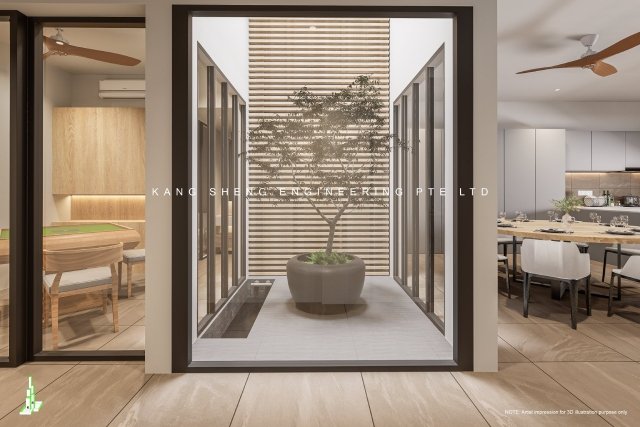
A truly biophilic approach goes well beyond potted plants on a shelf. It encompasses the thoughtful integration of natural light through skylights and open corridors, natural materials like timber and stone, vertical gardens both inside and outside the home, and even the sound of water features. In landed homes, where owners typically have far more freedom to modify the structure than condo dwellers, the possibilities are genuinely exciting.
In practice, this trend shows up in living walls that double as natural air purifiers, in timber ceilings and screens that add warmth without visual clutter, and in central courtyards that pull daylight deep into the home. Some homeowners are even incorporating small ponds or water gardens at entry points, a nod to both aesthetics and the age-old belief that water at the entrance brings positive energy.
3. Sustainable and energy-efficient design
Sustainability in landed home design is increasingly the expectation. A PropertyGuru survey found that 58% of Singaporeans are willing to invest in a sustainable home, and that appetite is reflected in what homeowners are requesting when they build or renovate.
The Building and Construction Authority (BCA) has long championed green building through its Green Mark certification scheme, and Singapore’s Green Plan 2030 sets the ambitious target of greening 80% of buildings by gross floor area by 2030. For landed homeowners, this translates into practical design choices: solar panels that can cut electricity bills by 30% to 50%, rainwater harvesting systems for garden irrigation, double-glazed windows to reduce heat gain, and passive cooling strategies that minimise reliance on air-conditioning.
What is particularly encouraging is that sustainable features no longer look like an afterthought. Modern solar panels sit flush with rooflines. Rainwater tanks are integrated discreetly into landscaping. Cross-ventilation is designed into the home’s orientation from the outset, so it feels natural rather than engineered. And with eco-conscious buyers willing to pay a 5% to 10% premium for sustainably designed homes, the investment increasingly makes financial sense as well as environmental sense.
4. Smart home integration
A decade ago, a “smart home” in Singapore typically meant a few automated lights and a fancy intercom system. Today, the level of integration on offer is in a completely different league, and homeowners building or renovating landed properties are taking full advantage.
Modern smart home systems for landed properties can manage everything from air-conditioning and lighting schedules to security cameras, door access, and even water leak detection, which are all controllable from a smartphone. For families, the appeal is obvious: convenience, energy savings, and peace of mind. For the design itself, smart integration also means less visual clutter. Controls are consolidated into sleek panels or hidden entirely behind voice-activated systems, keeping walls clean and interiors uncluttered.
Equally significant is the way smart systems support sustainability goals. Adaptive lighting that dims when natural daylight is detected, HVAC systems that adjust based on occupancy, and smart meters that track energy usage in real time all help households reduce consumption without any deliberate effort. It is sustainability made effortless, and that is a compelling proposition in a city where people lead busy lives.
5. Flexible, multi-generational living spaces
Singapore’s demographic reality is shaping the way landed homes are designed at a fundamental level. With many families choosing to house multiple generations under one roof, the traditional layout of reception room downstairs and bedrooms upstairs simply does not cut it any more.
What homeowners are asking for instead are homes with genuine flexibility: an en-suite bedroom on the ground floor that can serve as grandparent quarters today and a home office tomorrow; a basement level that functions as a recreation room now but could be converted into a separate studio unit later; open-plan living areas that can be reconfigured with sliding partitions when privacy is needed. The emphasis is on designing for life’s changes rather than for a single snapshot in time.
This thinking also drives the popularity of dual-key or semi-detached style layouts within single landed plots, where adult children and their parents share a roof but maintain distinct living areas. It reflects a pragmatic and deeply Singaporean approach to home design, one that balances togetherness with the need for personal space.
Conclusion
If these trends have sparked ideas for your own home, the next step is finding the right team to bring your vision to life. At Kang Sheng Engineering, we offer comprehensive design-build services and general contracting services for both residential and commercial projects. Whether you are planning a full landed house rebuild, a major renovation, or a commercial fit-out, our experienced team handles every aspect of the project under one roof.
Working with a single, integrated team means fewer miscommunications, tighter timelines, and a smoother journey from concept to handover. Contact Kang Sheng Engineering today to discuss your project and find out how we can help you build something truly worth coming home to.